
If you have a hillside lot in Austin, Wimberley, Dripping Springs, or anywhere else in the Texas Hill Country, you know the challenge. The views are amazing. The cedar and live oak are incredible. But that slope in your backyard? It erodes just a little more each time a thunderstorm hits.
Think of a retaining wall as an investment that gives you way more than you expect. Sure, it holds back dirt, but done properly, it can also prevent further erosion from stealing your yard, create a beautiful flat space where there wasn’t any, and totally transform the appearance (and resale value) of your property. When done right, a good wall doesn’t just fix a problem. It creates one of your outdoor living area’s best assets.
But no two walls are designed the same, and here in the Hill Country, that’s more true than anywhere. From caliche hardpan to fractured limestone to expansive clay soils to rainstorms that swing from dust-bowl dry to flash flood in hours, the Texas Hill Country throws a lot at your wall. Hiring a local company that knows these soil conditions isn’t optional, it’s the difference between a wall that will stand for generations and a wall that cracks and heaves after just a few years. We’ve built retaining walls throughout this area for years, and we know what works.
Natural Austin Stone & Limestone
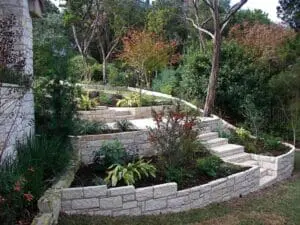
Not only is limestone everywhere you look in Texas, from Barton Creek to the Wimberley square, but it’s also what the Hill Country is actually made of. Building with native Austin stone will make your wall look like a natural part of the landscape because it literally is.
Why it works: This rock is extremely dense and solid, which makes it naturally resistant to Mother Nature’s elements. It won’t fade, rust, or degrade like manmade materials, only growing more attractive with age as it weathers and grows a soft patina.
Pros: Unbelievable longevity, classic Hill Country beauty, naturally repels inclement weather, and locally sourced (meaning less expensive and helps support local businesses).
Style options: Depending on the cut and finish, there are many different styles of limestone wall available.
- Chopped stone is neatly squared off at the edges, with even sizing throughout. Clean cut and contemporary, chopped stone is perfect for modern farmhouse or transitional styles.
- Moss rock and fieldstone both have uneven edges and an organic variation. Rounded edges and natural shapes allow moss rock and fieldstone to effortlessly mingle with native landscaping. Property owners who desire a “this has always been here” look will love fieldstone.
It wouldn’t be Hill Country landscaping without limestone. Our top pick for clients looking for the perfect combination of beauty, durability, and authenticity.
Segmented Block Walls
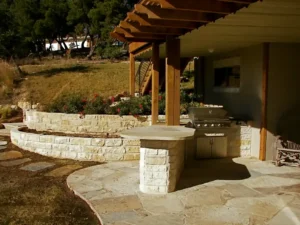
For projects that demand high-performance slope heights exceeding 4 feet, terraced or stepped retaining systems, retaining walls that must resist significant lateral loads, and segmented retaining wall blocks were engineered.
Engineered to perform: Segmented block walls can be built with geogrid reinforcement, allowing strips of high-tensile-strength mesh to be woven into the hill or slope behind the wall at regular intervals. This essentially anchors the wall into the body of the hill, creating much greater stability for taller segments of the wall.
Aesthetic options: Segmented block walls come in various textures, finishes, and colors, ranging from rugged, natural stone appearances to smooth faces. They can be used in very minimalist, modern settings as well as the traditional multi-stepped “staircase” arrangement with planting beds between each step.
Pros: Exceptional internal drainage (we’ll get to why that’s important in Texas in a moment), uniformity of structure from block to block, and economical at big sizes where stone becomes too expensive.
Another bonus of segmental/block walls can provide a uniform look, especially for homeowners with contemporary or modern ranch homes.
Steel & Corten Walls
Corten (aka weathering steel) retaining walls have been popular in Austin and throughout the Hill Country for the last few years, and for good reason. Simply put, Corten can make a big architectural statement with very little footprint.
Style: Corten gets its color from oxidation, resulting in a deep, mottled orange-brown patina. This isn’t rust or decay, by the way, it’s completely intended! You’ll notice most Corten walls are constructed of thin-profile panels, which contribute to an overall “crafted” look that feels very purposeful. It’s also a huge contrast to the heavy texture of stone walls.
Works well in the Hill Country: Corten walls go hand in hand with “Modern Ranch” or mid-century modern style homes. Think clean rooflines, big windows, and lots of exposed wood and steel. The rusted-metal color actually works well with the natural Hill Country palette when surrounded by limestone and native grasses.
Saves space: Because Corten walls are thinner than traditional stone walls, they work well in areas where a large stone wall would take up too much space. The panels are stiff enough to hold soil in places that masonry can’t, like tight side yards, small setbacks, or urban infill lots.
If you have a modern home and want your landscaping to look as if it were engineered from the ground up, Corten walls exude a level of intention that is hard to beat.
Boulder Walls
When it comes to large-scale properties, ranches, acreage, hillside homes with significant changes in grade, boulder walls have what the others don’t: big, bona-fide impact that looks organic, not man-made.
The aesthetic: Boulder walls have heft. Installed correctly, they don’t look like a wall. They look like something that was unearthed. By using large chunks of local rock in irregular sizes and patterns resembling natural formations, a master landscaper can construct a wall that mimics the endless rock walls found throughout the Hill Country.
Ideal for: homeowners who want to emulate the natural bluff lines found along the Guadalupe, Blanco, or Pedernales Rivers, think rugged, multi-tiered limestone cliffs that you see atop the Hill Country’s most picturesque hills. Boulder walls are also ideal for containing large slopes on acreage properties where a structured, engineered wall wouldn’t make sense.
There’s an art to placing each giant boulder so that the wall is structurally sound and looks beautiful. When installed correctly, a boulder wall is hard to beat.
Critical Considerations for Retaining Walls in Texas
As we mentioned earlier, material is just one factor to consider. Engineering and construction are equally important, and in Texas, there are some unique requirements.
Mind your drainage. All too often, we see retaining walls fail because proper drainage was not considered. In Texas, heavy rains can cause mud behind a wall to become saturated. Hydrostatic pressure builds against the wall until it pushes the wall over from behind. Correct installation requires gravel as backfill directly behind the wall, weep holes (small openings near the bottom of the wall) to allow trapped water to escape, and, frequently, a perforated drain pipe along the base of the wall to help convey water away. Details like weep holes and drain pipes are not “nice to haves” for your wall. They are required to structurally support it.
Know your foundation: clay vs. rock. Soil composition can vary wildly from one neighborhood to the next here in the Hill Country. Heavy clay soils (common in the suburbs of Austin) expand and contract with moisture fluctuations, causing movement that can deform a wall if the footings aren’t deep enough. But rocky soils aren’t always smooth sailing either. While solid limestone bedrock makes for great bearing material, it may need to be fractured before setting your wall footing. Make sure your contractor visits the site and knows what’s below the surface before breaking ground.
Pull a permit. Did you know that any wall over 4 feet tall requires a building permit in most Texas cities? And that permit will, in most cases, require a stamped engineering plan. This requirement can vary from city to city and county to county, but it’s always a good idea to check with your local municipality before moving forward with a project. Not only do you open yourself up to liability if an unpermitted wall fails, but you’ll also need to retroactively obtain a permit should you need a wall repaired. Any professional landscape company should be able to guide you through the process.
Build it and Enjoy
Far from settling, a retaining wall gives you new options. That troublesome slope on your property that constantly sheds gravel and erodes every time it rains is leveled to create a patio, a tiered garden, a fire pit lounge, or a usable lawn. You regain space and utility you can use and enjoy every day, adding real value to your home.
Different sites call for different walls. Slope grade, soil conditions, home architecture, and your plans for using the space will all factor into what your ideal wall will look like. There’s no one-size fits all solution here, but there is a solution for your yard. Let’s talk.
Tired of losing ground?
Book a site visit with Blazek Landscapes. We will analyze your grade, discuss your soil conditions, go over material options that will work with your design and budget, and show you what can be done. If you are a fan of classic Texas limestone, clean-cut segmented block, trendy Corten steel, or natural Hill Country boulders, we can build it correctly, the first time.